



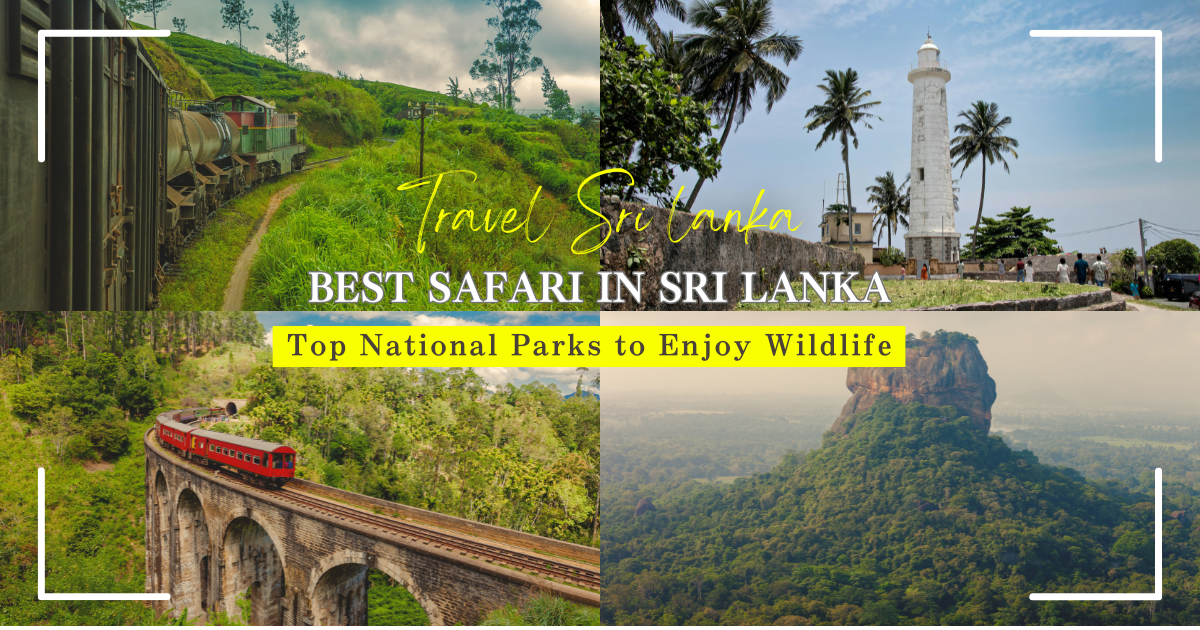
Sri Lanka is one of Asia’s premier safari destinations.
Visitors can enjoy diverse wildlife viewing, including the world’s largest herd of Asian elephants, forests with the highest density of leopards globally, and encounters with colourful endemic wild birds.
 Ravi
RaviThe compact island nation of Sri Lanka is dotted with expressive national parks, allowing visitors to experience multiple safaris even within a short period.
 Emma
EmmaFor travellers from Europe, it offers an appealing alternative to the typical African safari experience, providing a distinctively exotic adventure that is both safe and reasonably priced.
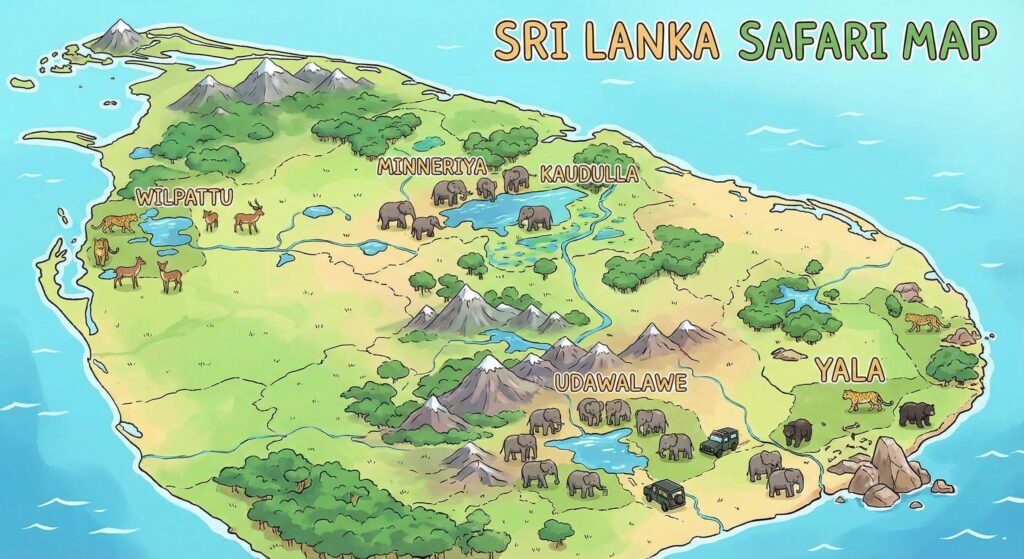
This time, we present a ranking of the top five most recommended safari national parks in Sri Lanka, based on the following criteria: the diversity of animal species, suitability for families with children, and ease of access.
We’ll also provide detailed explanations of each park’s best season, the animals you can see, the time required for the safari, approximate costs, and nearby accommodation information. Now, let’s take a look, starting with number one.
1st Place : Yala National Park
Yala National Park, situated in south-eastern Sri Lanka, is the country’s most renowned and most visited safari park. With a history as a hunting ground during the British colonial era, it is now celebrated as a national park protecting a rich ecosystem.
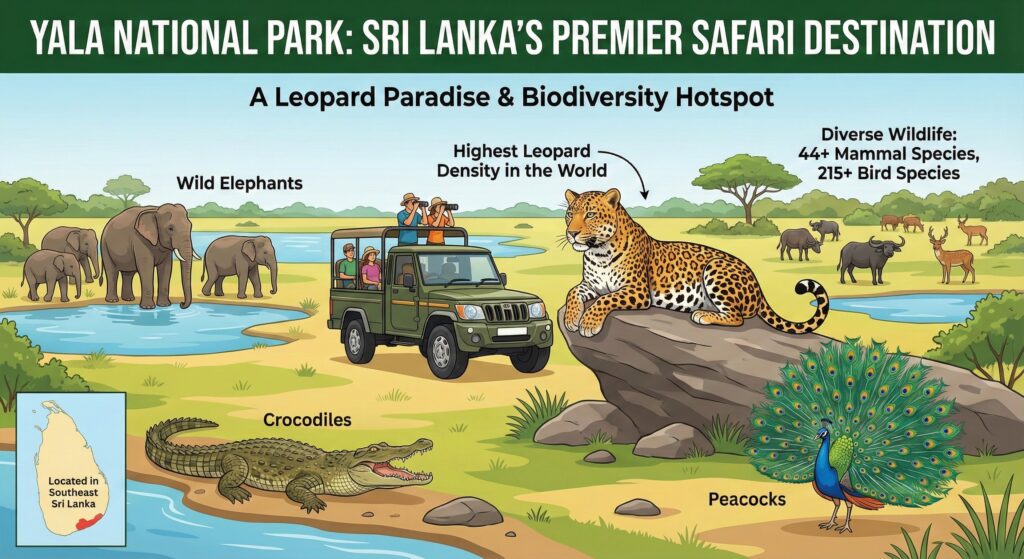
The Leopard’s Paradise It is also known as the Leopard’s Paradise, and its population density is said to be the highest in the world.
The Sri Lankan leopard, exceeding two metres in length, is the highlight of this park; with a bit of luck, you may encounter one strolling majestically through the forest or grasslands.
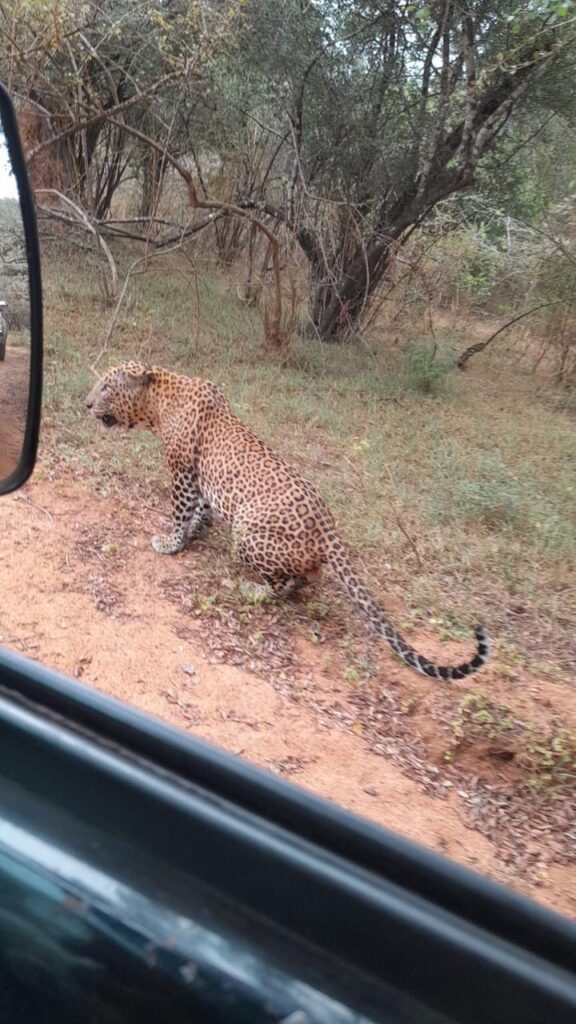
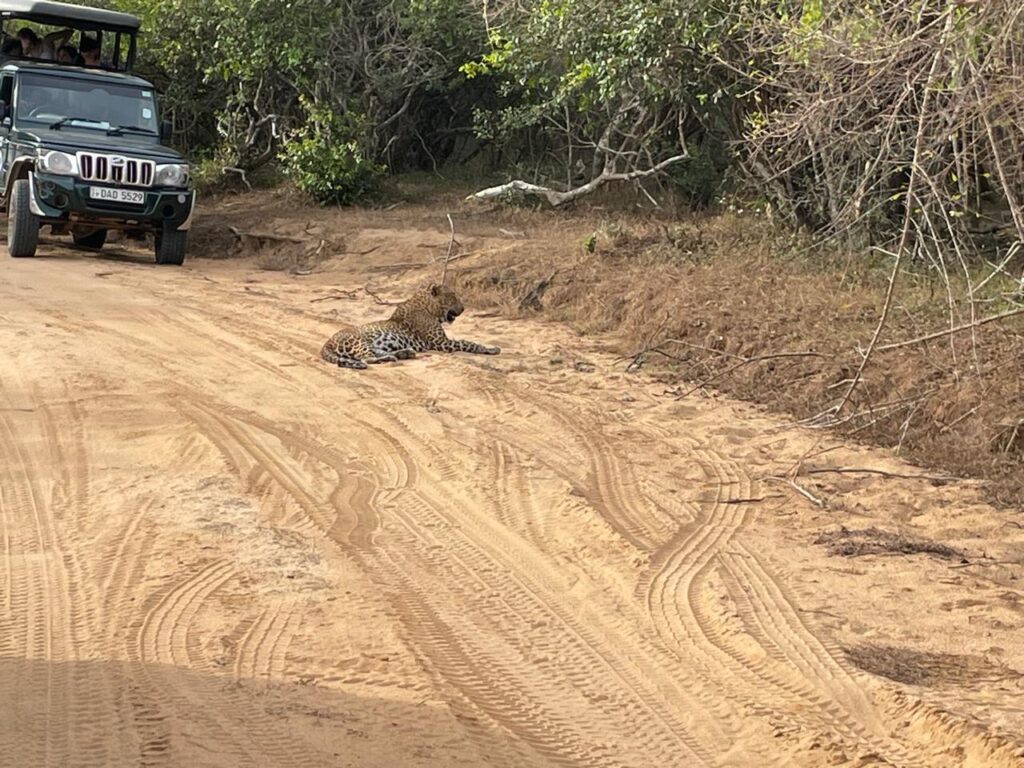
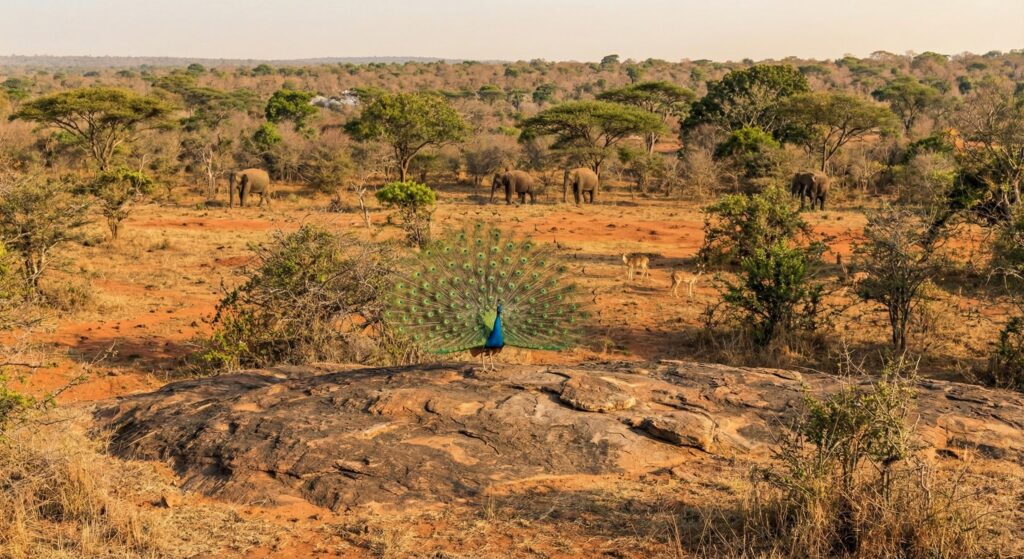
Moreover, over 44 species of mammals and more than 215 species of birds have been confirmed, including wild elephants, crocodiles, buffalo, deer, wild boar, monkeys, and peacocks, boasting Sri Lanka’s greatest animal diversity.
 Emma
EmmaIts open landscape, often described as ‘like the African savannah’, is another defining feature. Here, you can enjoy safaris amidst a scenery of lakes and ponds of varying sizes and sparse groves of shrubs.
Access: Approximately 5 to 6 hours by car from Colombo
Yala National Park is approximately 5 to 6 hours by car from Colombo, and about 4 to 5 hours from the southern coastal towns of Mattala and Galle.
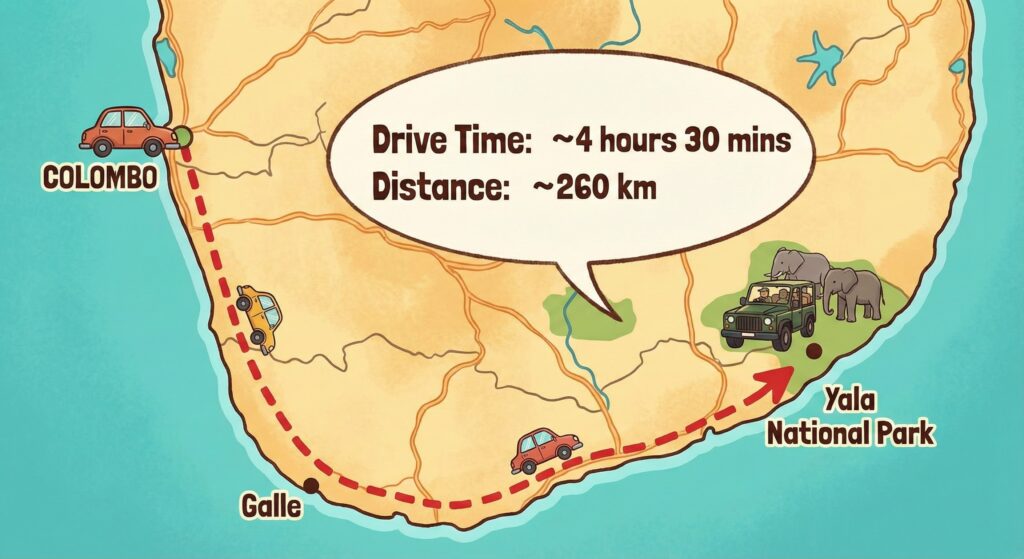
The gateway town to the park is Tissamaharama, where long-distance coaches also arrive and depart.
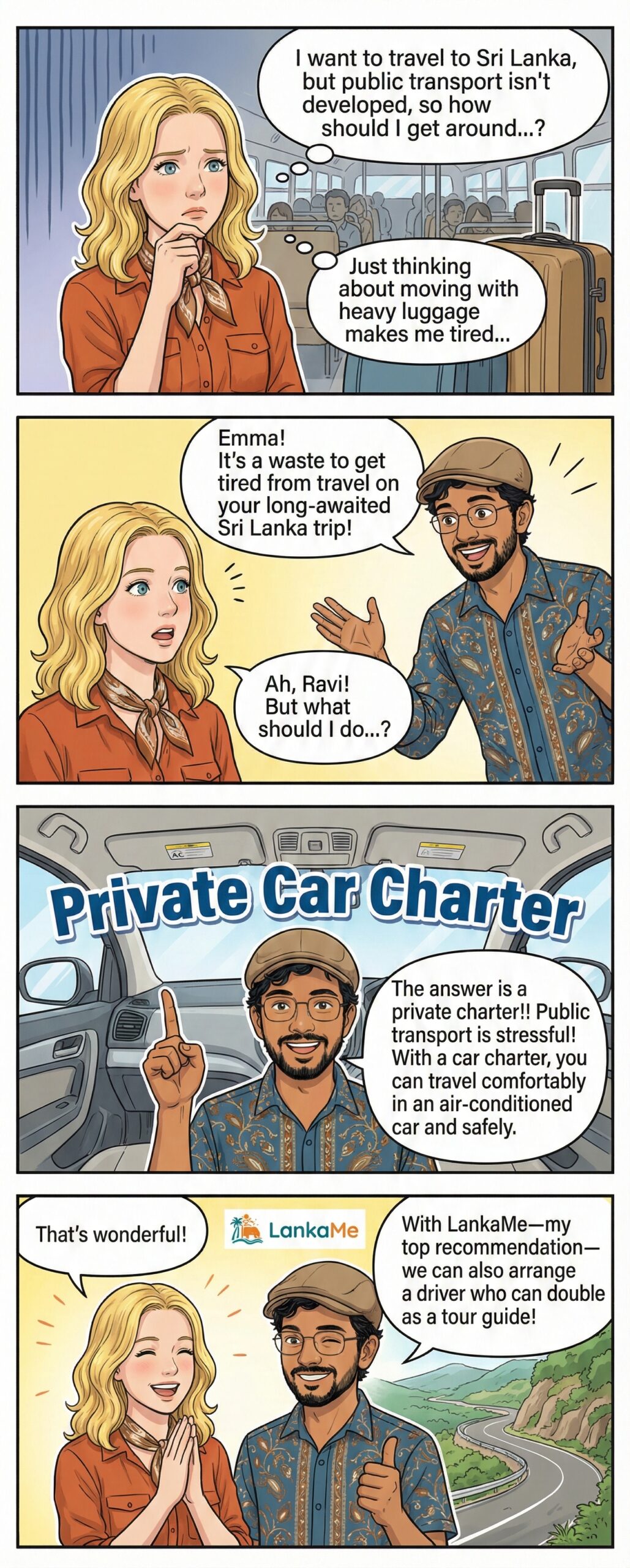
RaviHowever, considering the rest of your itinerary, a private charter is recommended! You can head straight towards Ella or head to beaches such as Mirissa.
EmmaWith LankaMe, they’ll not only arrange your transport but also handle guides and jeep bookings!
Many visitors come for day trips or overnight stays from nearby Algaum Bay, Ella, and southern beach resorts such as Mirissa and Tangalle. Safari tours within the park are only possible via game drives in jeeps (four-wheel drive vehicles), typically twice daily: from 6:00 am and from around 3:00 pm.
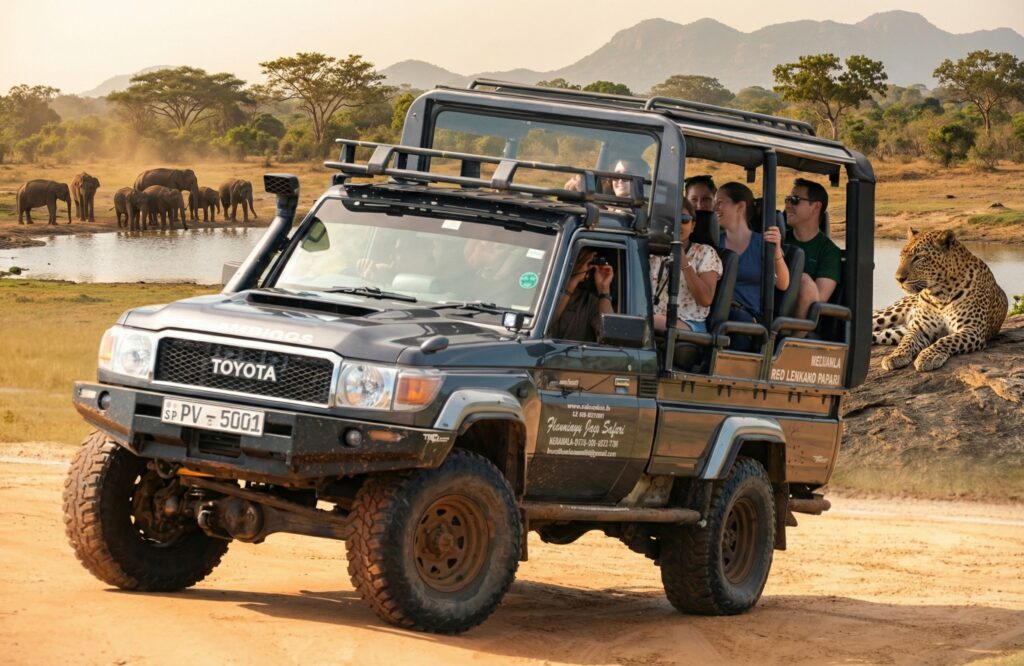
A typical half-day safari tour takes approximately three to four hours to cover the park.
Best season is February to July
Yala National Park is open year-round, though the dry season (roughly February to July) offers the best viewing conditions for wildlife. Particularly during the drier months of June to August, limited water sources draw animals to watering holes, increasing the likelihood of leopard sightings.
Meanwhile, from November to January, increased rainfall due to the northeast monsoon and the dense growth of the jungle make spotting wildlife somewhat more challenging. Please note that the park closes for approximately six weeks each year, starting in early September.
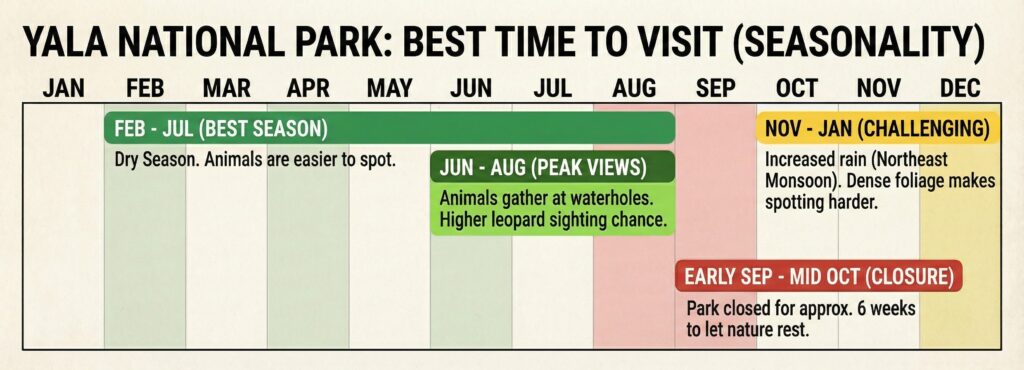
This is to allow nature to rest after the peak season, so please take note when planning your travels during this period.
Safari duration and
A typical jeep safari lasts half a day (approximately 3 to 4 hours). Early morning safaris commence around 6:00 am, while afternoon safaris start between 2:30 pm and 3:00 pm and continue until sunset. For those wishing to enjoy the experience more thoroughly, some operators offer full-day safaris.
As mentioned earlier, the private charter service LankaMe can arrange the most suitable jeep tours for travellers.
RaviDuring the safari, the roads may be bumpy and cause some jostling as you traverse the vast park grounds, but this only adds to the sense of adventure.
EmmaTo coincide with the animals’ most active period, it is necessary to depart the lodge in the early morning darkness (between 4 and 5 o’clock).
Rising early is hard work, but it increases the chances of encountering more wildlife during the cooler hours.
Admission fee and jeep tour price
The entrance fee for Yala National Park is approximately US$30–35 per adult for foreign visitors (including tax and service charge).
This varies depending on the number of people, with the per-person cost becoming more economical the more people share the same jeep. A discounted rate applies for children aged 6 to 12, while those under 6 travel free of charge.
The standard rate for chartering a safari jeep for a half-day private tour is approximately US$80 to US$100 per vehicle, which often includes entrance fees and the driver-guide’s fee.
Whilst slightly pricier than other parks such as Udawarawe, it remains considerably more affordable than an African safari. Considering the chance of encountering a leopard, it is arguably a very attractive price.
2nd place: Udawalawe National Park
Udawalawe National Park, located in the southern inland region of Sri Lanka, is renowned as a paradise for wild elephants.
The vast savannah-like environment surrounding Lake Udawarawe is home to an estimated 500 elephants. Particularly during the dry season, it is not uncommon to observe herds of nearly 100 elephants.
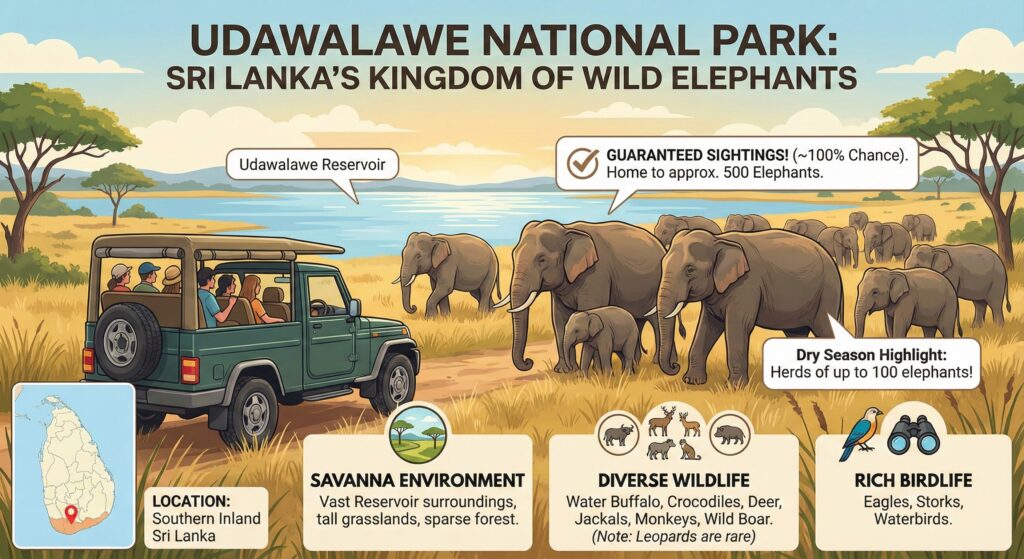
Within the park, where tall grasslands and sparse woodlands stretch out, elephants, water buffalo, crocodiles, deer, wild boar, jackals, and monkeys inhabit the area, while birds range from eagles and storks to diverse waterfowl.
Although leopards are present, sightings in Udawalawe are rare, with elephants undoubtedly taking centre stage. It is said that “if you want to be certain of seeing wild elephants, Udawalawe is the place to go,” and indeed, you can encounter elephants with almost 100% certainty.
Elephants sometimes approach right up to the vehicle, allowing you to observe heartwarming scenes up close, such as baby elephants snuggling close to their mothers.
Access: Approximately 4 hours by car from Colombo
Udawalawe National Park is approximately four and a half hours by car from Colombo, about three hours from the southern coastal city of Matara, and approximately two to three hours from the central highlands town of Ella.
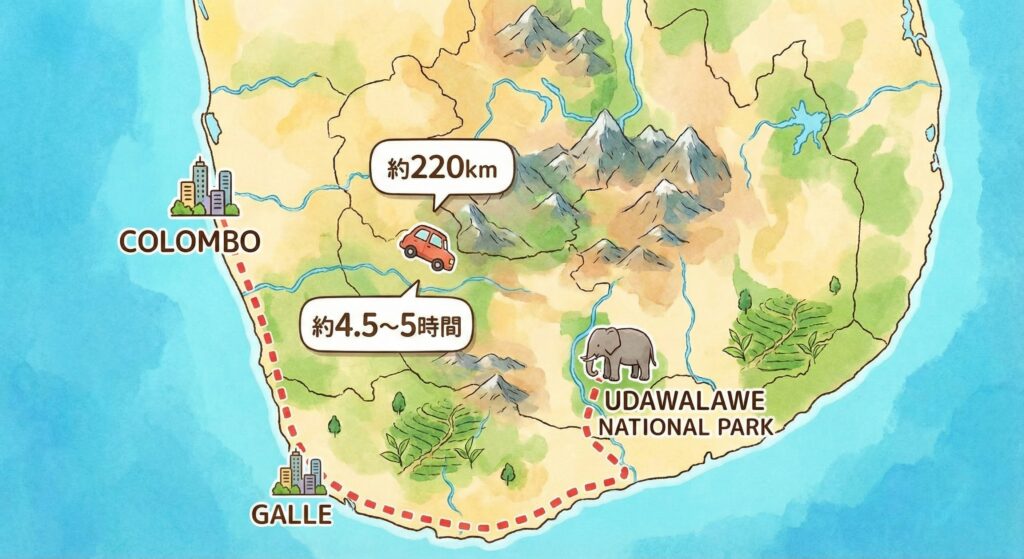
Some travellers make day trips from beach resorts on the southern coast (such as Mirissa or Unawatuna) or from the World Heritage site of Galle, whilst others may choose to stop off en route whilst travelling south from Ella.
The base towns around the park are Udawalawe or Embillipitiya, with accommodation ranging from mid-range hotels to guesthouses scattered throughout.
RaviDue to infrequent public transport services, we recommend chartering a private vehicle or joining a tour.
Best season is from May to October
Udawalawe is accessible throughout the year, but the best time to see animals is during the dry season (mid-May to September).
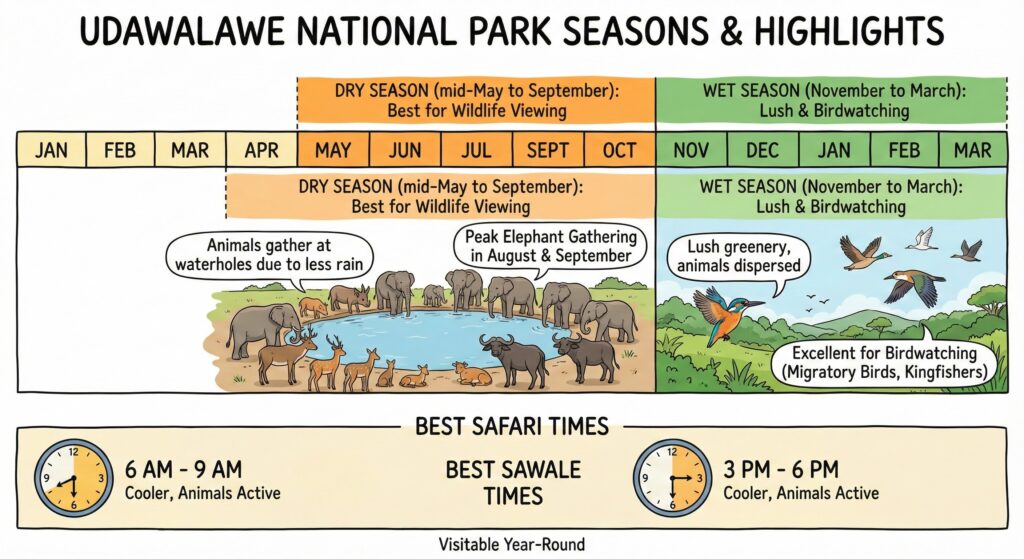
During this season, reduced rainfall leads to fewer water sources, causing elephants and many other animals to congregate more readily at watering holes. Particularly in August and September, the gathering of elephant herds at the water’s edge is a truly spectacular sight.
The rainy season (November to March) sees lush greenery and beautiful scenery, though animals become dispersed, requiring careful searching. However, November to March is also the migratory bird season, making it ideal for birdwatching.
For instance, many bird species can be observed, such as winter visitors from the Eurasian continent and the colourful kingfisher family. Mornings and evenings are cool, making animals more active, so the prime times for safaris are around 6–9 am and 3–6 pm.
Safari duration
As with Yala, half-day safaris (approximately 3 to 4 hours) are the norm. The morning schedule typically starts around 6 o’clock and finishes between 9 and 10 o’clock, while the afternoon schedule generally runs from around 3 o’clock until sunset.
EmmaThe paths within the park are relatively flat and easy to run on, and the travel time is not as long as Yala.
RaviTherefore, you should be able to locate animals efficiently in a short time.
On the morning safari, you can observe the silhouettes of elephants emerging across the grasslands bathed in the dawn glow, whilst in the evening, the sight of the herd illuminated by the setting sun is highly photogenic.
Some operators in Udawarawe offer short courses lasting one to two hours, making it easy to participate even when time is limited. However, as the animals are unpredictable, we recommend taking half a day to search thoroughly if possible.
Admission fee and jeep tour price
The entrance fee is the same as Yala, approximately US$30–35 for adults, but Udawalawe is generally cheaper for safari tours.
For instance, even when hiring a private jeep, the cost is often comparable to Yala’s shared tours, making it an attractive option for its excellent value for money. Negotiating directly with drivers locally can sometimes secure a half-day private hire for around $50 to $70 per vehicle.
Arrangements made through accommodation providers or tours with English-speaking guides typically cost around $70 to $100 per person (including transfers), yet even for a family of four, the total comes to approximately $200 – considerably more affordable than in Africa.
Child discounts are also available, and children under six travel free, making it a welcome feature for family trips. Moreover, compared to the vast grounds of Yala, the shorter distances mean you can enjoy the luxury of taking your time in a privately chartered jeep to search for wildlife at a reasonable price.
3rd Place: Minneriya National Park
Minneriya National Park, situated in the cultural triangle of central Sri Lanka, is renowned as the location where the world’s largest gathering of wild elephants can be observed.
Within the park lies the Minneriya Reservoir, constructed during the ancient dynastic era. During the dry season, hundreds of elephants from across the island converge here in search of water and food. This spectacular sight is known as ‘The Gathering’, peaking annually between July and October.
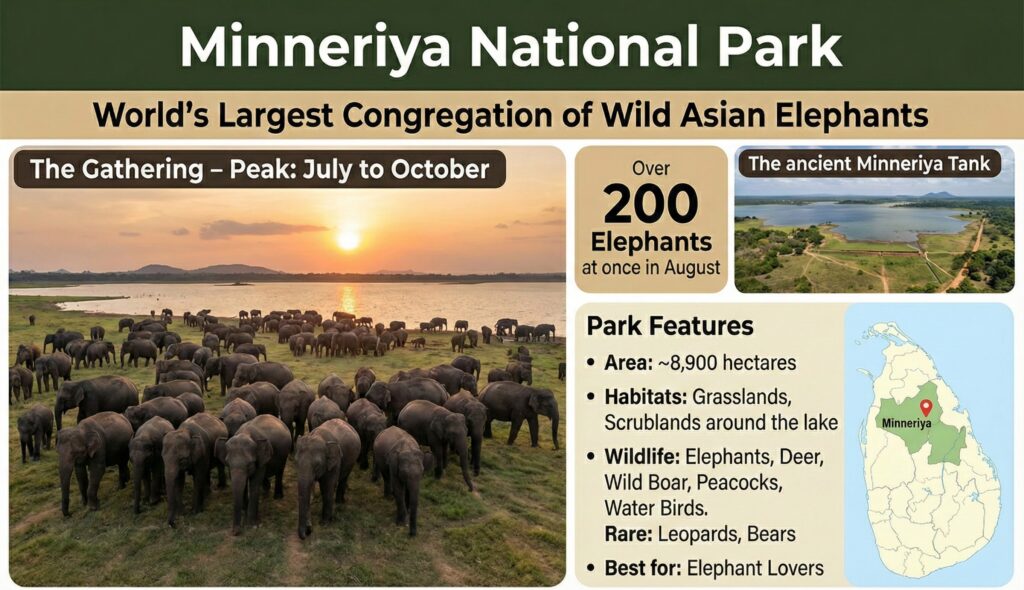
Particularly around August, over 200 elephants at a time may gather on the lakeshore, offering an elephant safari experience on a scale unmatched anywhere in the world outside Africa.
Minneriya is relatively small in size, covering approximately 8,900 hectares, yet the grasslands and sparse woodlands surrounding the lake are home to elephants, deer, wild boar, peacocks, and waterfowl.
EmmaAlthough leopards and bears have been reported to inhabit the area, sightings are rare due to the prevalence of tall grasslands, making it truly a park for elephant enthusiasts.
Access: 4 to 5 hours from Colombo
Minneriya National Park is conveniently located approximately 30 to 40 minutes by car from Sigiriya’s Lion Rock and the ancient city of Polonnaruwa, making it ideal for day safaris from these tourist destinations.
It takes four to five hours by car from Colombo, but you can also take an intercity bus to Dambulla or Habarana and join a jeep tour from there.
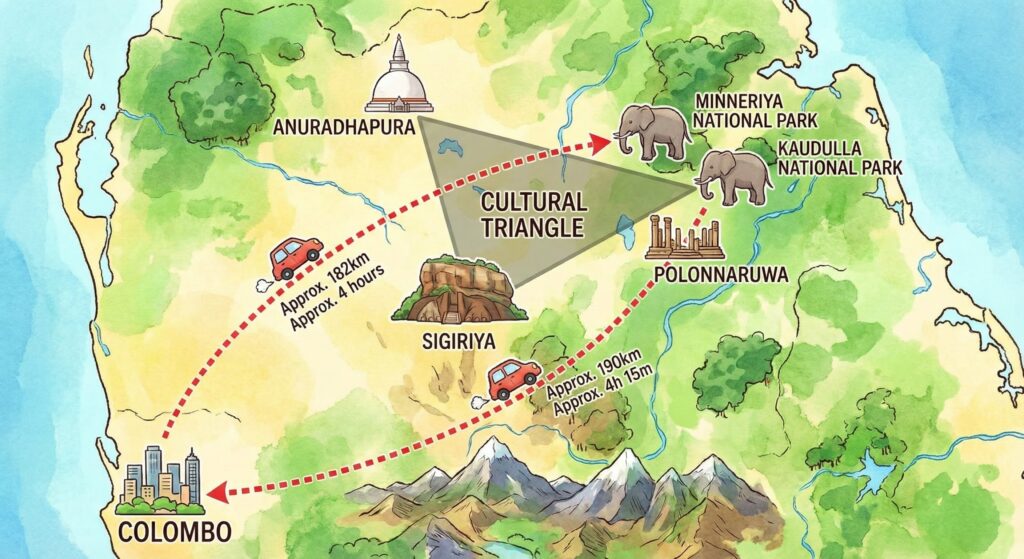
The park’s main gate is situated along the main road between Habarana and Polonnaruwa, with safari jeep operators and motorcycle rental shops dotted around the vicinity.
In terms of accessibility, Minneriya’s strength lies in its convenient location for easy incorporation into itineraries exploring the Cultural Triangle.
Best season is from July to October
The best time to visit Minneriya to witness the mass gathering of elephants is during the dry season (late June to October).
Particularly from July to September, as reservoir water levels drop, young grass emerges across vast areas, drawing elephants together in search of it. August sees the greatest gathering, creating a truly spectacular elephant paradise unique to this location.
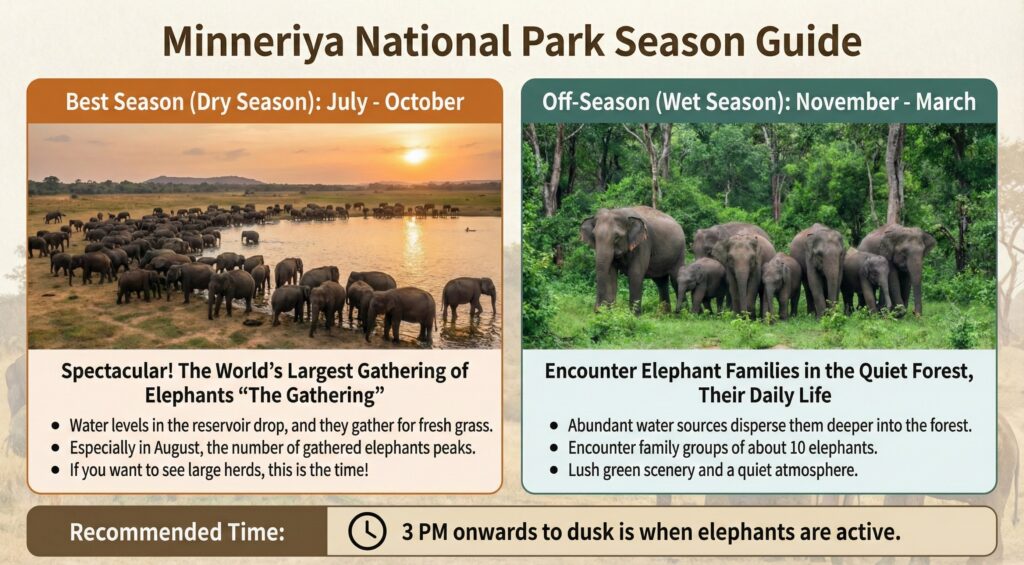
Conversely, from November to March as the rainy season begins, water sources become plentiful, causing elephants to disperse deeper into the forest, resulting in smaller herd sizes.
During the rainy season safaris, one typically encounters family groups of around ten individuals, yet one can still enjoy the tranquil forest atmosphere alongside the lush green landscape.
EmmaEven during the rainy season, you may be fortunate enough to spot elephants by the lakeside, so it’s not necessarily advisable to avoid visiting.
RaviHowever, if you wish to guarantee sightings of large elephant herds, visiting during the dry season is the golden rule.
The period after 3pm is when elephants are most active, and over the next few hours until dusk, one elephant after another appears along the lakeshore.
Safari duration
Generally, the afternoon half-day safari (starting around 2:30 PM and finishing at 6:00 PM) is recommended.
EmmaElephants gather at the water’s edge during the late afternoon when the midday heat subsides.
RaviWith approximately three hours, you can cover the lakeside area and observe a sufficient number of elephants.
Morning safaris are also available, though elephants tend to remain in the forest during the early hours, making encounters with large herds less likely.
RaviWhile mornings offer opportunities for birdwatching or spotting nocturnal animals like jackals, the afternoon remains the recommended time to visit Minneriya.
The safari itself is relatively short, so it is possible to combine it with a visit to the nearby Kaudulla National Park. Indeed, some travellers enjoy both parks in a single day, visiting Kaudulla in the morning and Minneriya in the afternoon.
Admission fee and jeep tour price
The admission fee for foreign visitors is approximately US$25–30 per adult (excluding management fees and taxes). *The Sri Lankan government sets admission fees in US dollars, so the amount fluctuates with exchange rates.
Jeeps can be chartered around Habarana, with rates typically ranging from US$30 to US$50 per vehicle for half a day.
EmmaAs with other safaris, LankaMe can arrange the best jeep tours through our drivers.
RaviDepending on the circumstances at the time, we will arrange a safari jeep for you to visit either Minneria National Park, Kadulla National Park, or Hulu Elephant Park – whichever offers the highest likelihood of witnessing the largest elephant gathering!
With multiple people sharing the ride, the cost per person is a reasonable $10 to $20. As the park itself is small, petrol costs are low, making it appealing that you can enjoy a safari on a low budget overall.
Local hotels and travel agencies offer guided tours with transfers (including an English-speaking guide) for around $50 per person. Please note that there is no special arrangement with Kaudulla National Park, as described later, whereby paying the entrance fee for one park grants access to the other on the same day.
As each park incurs a separate admission fee, you must decide which park to visit beforehand and purchase tickets accordingly. However, most travellers need not worry, as upon arrival, the guide will take you to whichever park is deemed best.
4th place: Kaudulla National Park
Kaudulla National Park is another elephant sanctuary adjacent to Minneriya National Park.
Located approximately 30 kilometres northeast of Minneriya, it too consists of grasslands and forests centred around a vast reservoir lake (Kaudulla Lake).
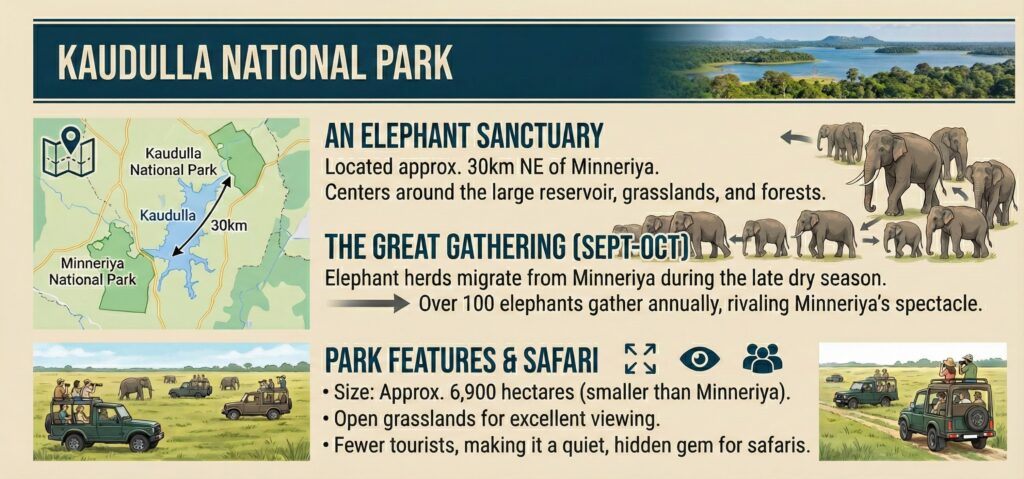
Located along the same elephant migration route as Minneriya, Kaudulla is renowned for its ‘gathering’ during the latter part of the dry season, from September to October, when herds migrate from Minneriya to Lake Kaudulla.
Indeed, every year around September, over 100 elephants are sighted here, creating a mass gathering rivalling Minneriya. Though the park’s size is approximately 6,900 hectares, slightly smaller than Minneriya, its open grassland surroundings make it ideal for elephant viewing. With fewer tourists than Minneriya, it is a hidden gem where one can enjoy a quiet safari.
Access: 4 to 5 hours from Colombo
It is a four to five-hour journey from Colombo.
Kaudulla National Park is also accessible by car in approximately 45 minutes from Habarana and about an hour from Polonnaruwa. The park entrance is near the small village of Gal Oya, surrounded by even more rustic countryside than Minneriya.
EmmaPublic transport is scarce, so Minneria wins hands down in terms of accessibility.
RaviUsing a private charter in combination with nearby tourist spots is the most efficient way to go!
However, as the distance from nearby accommodation and safari operators is not significantly different, arranging a jeep in advance will suffice.
From hotels in Hapalana and Sigiriya, the journey time is comparable to that for Minneriya. Therefore, from a tourist’s perspective, Minneriya and Kaudulla can be considered an area that can be accessed as a single, integrated package.
Best season is from September to October
July and August see elephants concentrated in Minneriya, meaning Kaudulla is somewhat less populated. Therefore, Kaudulla’s best season is September to October.
During this season, as the water level in Minneriya Reservoir drops, many elephants migrate to Kaudulla Lake, gathering to feed on the grasses spreading along its shores.
September in particular sees the elephant population reach its peak, offering visitors a chance to witness large herds amidst relatively fewer tourists.
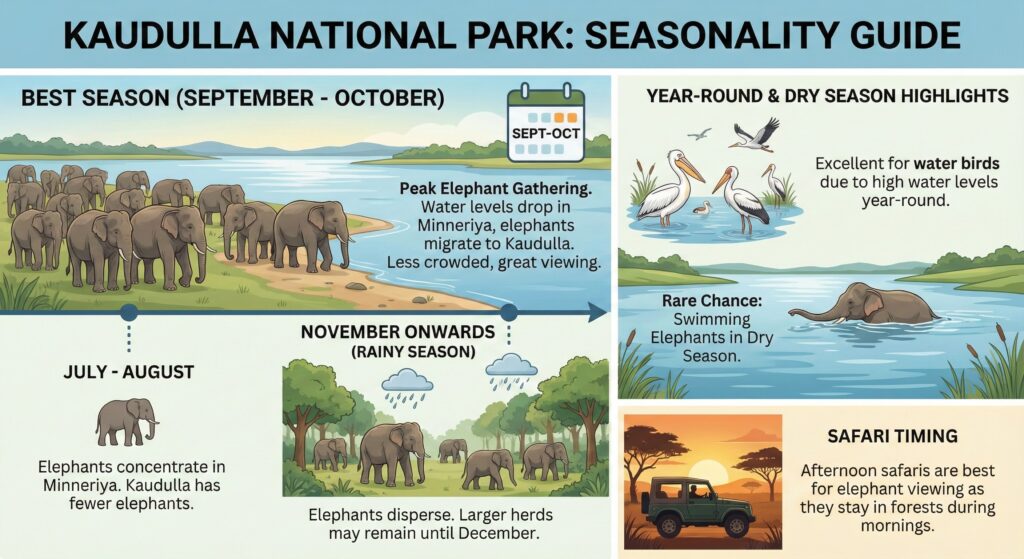
From November onwards, as the rainy season begins, elephants once again disperse throughout the forest, though relatively large herds may remain until around December. Furthermore, Lake Kaudulla maintains a high water level throughout the year, making it well-suited for observing waterfowl.
RaviEven during the dry season, wetlands where pools of water linger attract pelicans and storks, and with a bit of luck, you might encounter the rare sight of elephants swimming across the water (elephants crossing the lake).
Similarly to Minneriya, if your primary purpose for visiting is to see elephants, an afternoon safari is more suitable. This is because elephants tend to remain within the forest during the morning.
Safari duration
The basic safari style is the same as Minneria’s, with the half-day afternoon course (approximately 3 hours) being the standard option.
It would be easier to arrange a schedule where you do other sightseeing in the morning and the safari in the afternoon. Note that the entrance to Kaudulla National Park is in a remote location, and it takes 30 to 40 minutes by jeep from the gate to the lakeside area where you can actually see many animals.
RaviTaking this travel time into account, the actual time available for observing animals within the park is around two hours.
EmmaThat said, the main elephant search takes place on open grassland, so even a shorter time than Minneriya is sufficient to achieve the objective.
Please rest assured that our guides will split up to locate the elephants, sharing information via radio as they guide you. Please note that the day after rain, muddy paths may render certain areas inaccessible.
To ensure an efficient tour in the shortest time possible, we recommend entrusting your journey to our experienced drivers who are thoroughly familiar with the terrain.
Admission fee and jeep tour price
The entrance fee for Kaudulla National Park is set at approximately US$20 per foreign visitor, making it slightly cheaper than the neighbouring Minneriya National Park.
This is due to differences in park size and facilities, but there is little difference in the safari experience itself. Jeep hire costs are also comparable to Minneriya, at around US$30–50 for a half-day private hire.
In other words, cost-wise, there is little difference from Minneriya, so you can simply choose whichever is available at the time.
EmmaLankaMe will arrange a safari jeep for you at Minneriya National Park, Kaddulla National Park, or Hulu Elephant Park – whichever offers the best chance of spotting elephants!
Some tour companies offer packages titled ‘Visit to Minneria or Caudulla (decided on the day)’, providing flexible itineraries that guide you to the best destination on the day.
According to the local guide, “To see the great elephant gathering, be flexible about the park name.” Therefore, to maximise value for money, don’t fixate on one place; consult a professional.
5th Place : Wilpattu National Park
Wilpattu National Park is the largest and oldest national park in Sri Lanka, stretching across the north-western part of the country.
The area spans approximately 1,317 square kilometres and is dotted with over fifty lakes and marshes (commonly known as villu), hence its name in Sinhala meaning ‘land of lakes’.
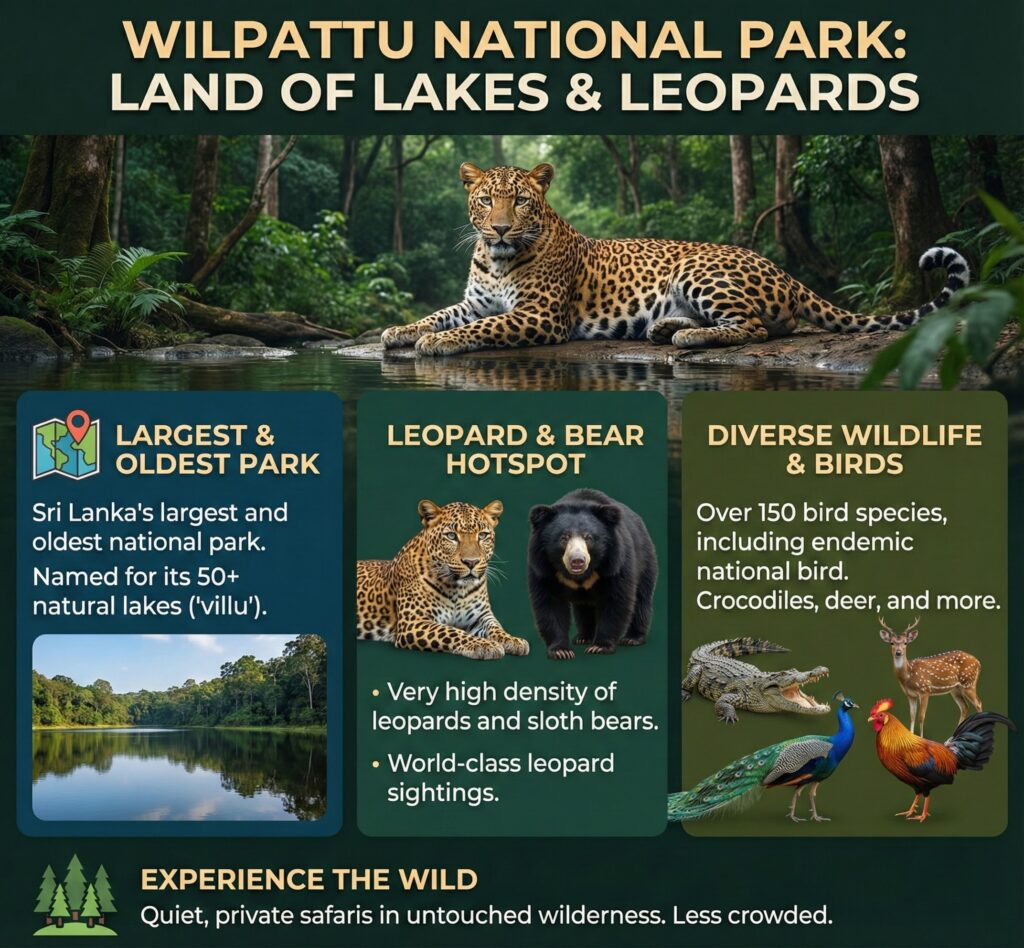
The vegetation consists mainly of dense forests and shrublands typical of arid regions, with deeper, more untouched forests than in Yala, lending it a more pristine, wilderness feel.
For a long time, access for tourists was restricted due to the effects of civil war, but in recent years, with the return of peace, its popularity has gradually increased.
Nevertheless, visitor numbers remain lower than at other parks, making it a hidden gem where one can enjoy a private safari amidst tranquil wilderness.
RaviWilpattu’s greatest attraction is its exceptionally high density of leopard and sloth bear populations. Some theories even suggest it surpasses Yala, with researchers reporting that its leopard population per 100 square kilometres ranks among the highest in the world.
EmmaThe park’s dense forest makes spotting wildlife more challenging, but the thrill of an encounter is all the greater for it.
Additionally, a diverse array of mammals inhabits the area, including Sri Lankan elephants, Sri Lankan sloth bears, muggas (crocodiles), hog deer, wild boar, and banteng (Sri Lankan wild cattle), with even nocturnal slow lorises (spectacled langurs) residing here.
Approximately 150 species of birds have been recorded, including pelicans and storks along the water’s edge, peacocks and eagles within the forest, and the Sri Lankan endemic Ceylon Serpent Eagle (the national bird).
Wilpattu, with its vast stretches of untouched virgin forest, offers wildlife the freedom to roam largely undisturbed by human influence. With a bit of luck, you might spot a leopard drinking from a roadside pool or a bear suddenly emerging from the jungle thicket.
Access: 4 hours from Colombo / 1 hour from Anuradhapura
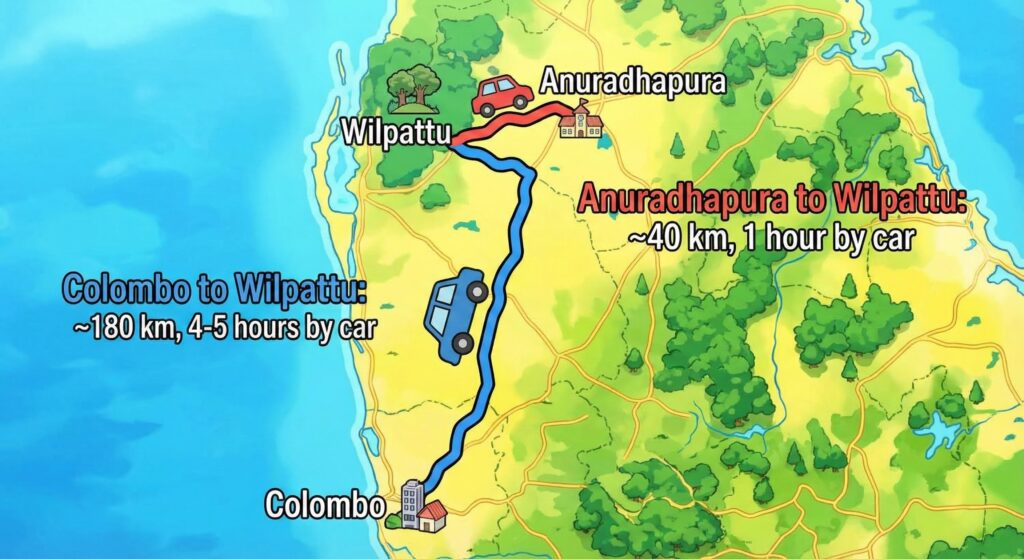
The main gate (Hunwilla Gama) of Wilpattu National Park is located approximately 180 kilometres north of Colombo, a journey of 4 to 5 hours by car. By public transport, one must take a bus from Colombo bound for Puttalam or Anuradhapura, and from there travel approximately 30 kilometres by taxi or similar means.
 Ravi
RaviThere are no railway stations in the vicinity, so travel is primarily by car. As a tourist route, it is often combined with visits to the ancient city of Anuradhapura, or extended from the Kalpitiya area (famous for dolphin and whale watching tours).
Given the sheer size of the park itself, it’s best to plan for a full day’s safari. There are rest areas within the park, but no shops or facilities, so bring your own packed lunch and water.
A jeep booking office is located near the entrance gate, and same-day bookings are possible, though arranging in advance is recommended for a smoother experience.
Best season is February to around September
During the dry season, water levels in Wilpattu National Park’s lakes and marshes recede, causing animals to congregate at watering holes, making them easier to spot.
Particularly from May to August, the drought period, leopards and bears are said to become more visible as they seek water.
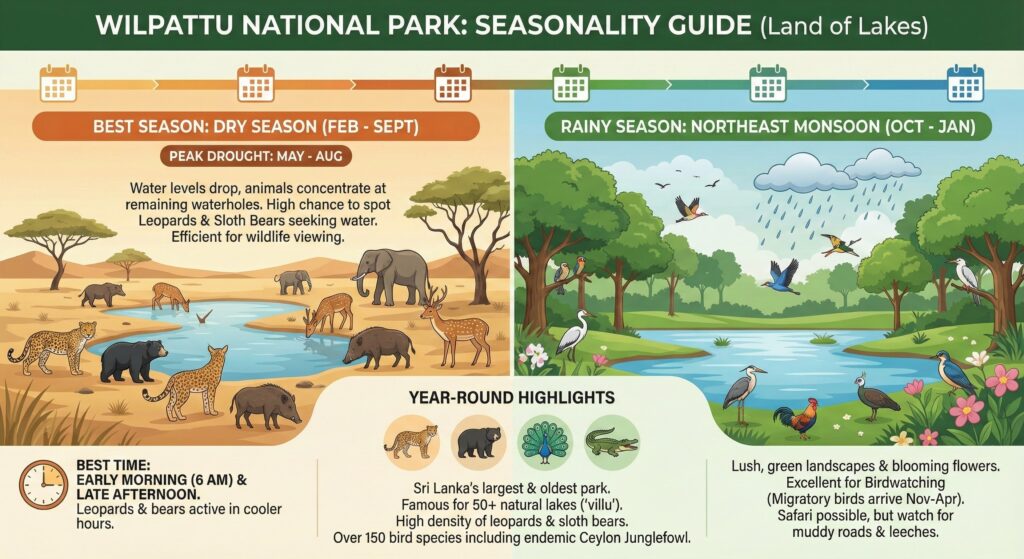
Conversely, October to January falls within the northeast monsoon rainy season, though annual rainfall is not as heavy as in Yala, meaning safaris are not impossible even during the rainy season.
EmmaThe rainy season brings lush green forests and a profusion of blooming flowers, creating a beautiful landscape and ideal conditions for birdwatching.
RaviMigratory birds arrive from November to April!
However, caution is required as routes may become impassable due to muddy conditions, and leeches may crawl onto vehicles. For first-time visitors, the dry season is best, and entering the park at opening time, around 6 a.m., is ideal.
Leopards and bears become active during the cool mornings and evenings, so begin your search just after sunrise. The morning forest is enveloped in the chorus of birds, offering a refreshing experience well worth the early rise.
Safari duration
At Wilpattu, due to the considerable distances involved in traversing the park, the full-day safari is the most common option. The schedule typically runs from the park opening at 6:00 am, with a break before noon, followed by driving in the afternoon until around sunset at 6:00 pm.
RaviHalf-day safaris are possible, but as the highlights are scattered, they tend to feel rushed.
EmmaIf you’re going to make the effort to visit, I recommend spending a full day exploring the remote areas.
Along the way, spreading out your packed lunch by the lakeside for a picnic is a unique experience only possible at Wilpattu.
Designated spots are available where you may alight from the jeep to rest, provided the driver has confirmed it is safe to do so. Simple toilet facilities are available at the entrance and several locations within the park. As the safari involves prolonged periods of motion, those prone to motion sickness should carry anti-nausea medication.
Binoculars with a telephoto lens are also useful for birdwatching. While your driver-guide will locate animals using tracks and calls as clues, be prepared for more patient waiting than at places like Yala.
However, by the time the safari ends, you should be filled with a sense of accomplishment and wonder.
Admission fee and jeep tour price
Entrance fees for Wilpattu National Park are approximately US$25–30 per foreign adult, with separate jeep charter costs of around US$100–120 per day (both costs can be split among the group). A half-day jeep tour costs approximately US$60–80.
RaviCompared to other parks, the longer distance and time involved mean it is slightly more expensive, but considering you can enjoy unspoilt nature, it is a cost that is certainly justified.
Luxury tented camps around the park, such as Leopard Trails, offer packages combining accommodation with guided safaris. Though costing several hundred dollars per night, they provide a truly luxurious experience.
For a more economical experience, utilising a local tour departing from and returning to Anuradhapura is convenient. Arrangements can be made from around $100 per person, inclusive of return transfers and a guide, though you may be sharing the vehicle with other travellers.
For the best safari experience
Finally, let’s cover the key points for enjoying the best safari experience in Sri Lanka.
As mentioned above, each park has its own attractions and best season, but conditions on the ground change daily due to weather and animal movements.
Particularly at Minneriya, Kaudulla and Hulu Leeku Parks, the location where large elephant gatherings can be observed varies depending on the day’s water levels and feeding ground conditions.
RaviTo avoid the situation where, despite making the effort to visit, you find out “the elephants have been moved to the neighbouring park today…”, flexible arrangements are key.
Local drivers and guides share the latest information via radio and know exactly where to go for the best views. Do leave it to the professionals to guide you to the finest spots that day.
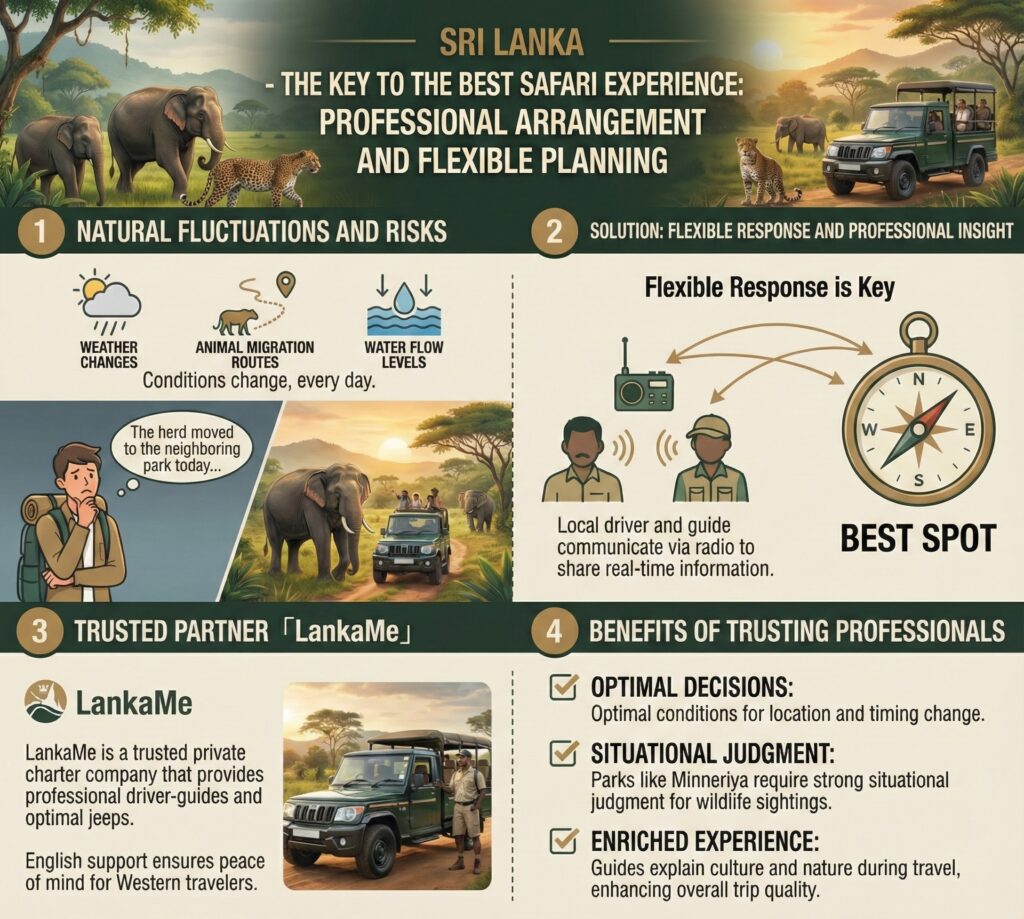
It is also wise to engage a reputable charter company for arranging jeeps for safaris. For instance, consulting a private charter company such as LankaMe will ensure you are provided with a driver-guide well-versed in each national park and the most suitable jeep.
We also handle enquiries in English, ensuring travellers from Europe and America can use our services with confidence. Particularly on safaris like Minneria and Kaudulla, where situational judgement is crucial, having the support of local professionals is reassuring.
“Which park should we visit today?” or “What time should we depart?” – entrusting such details to professionals like LankaMe ensures everything is taken care of. Having a dedicated driver-guide enhances the overall quality of your trip, as they can provide commentary on Sri Lankan culture and nature during your travels.
Summary
We have introduced the top five national parks in Sri Lanka where you can enjoy safaris. Each has its own unique characteristics, and encounters with diverse wildlife, from leopards to elephants, await you.
Whether travelling with family or as a couple, whether you’re an adventurer or a novice, a safari in Sri Lanka is sure to create special memories. Plan your trip during the best season and set out with a trusted guide to witness the drama of nature.
A safari in Sri Lanka promises thrills and excitement well worth the long journey from Europe. The thunderous footsteps of elephants treading the earth, the chorus of birds echoing through the jungle, the silhouette of a leopard silhouetted against the dappled sunlight—all beckon you towards an unknown adventure.

コメント